Portable Pellet Grills: Travel Checklist and Power Needs
Taking a portable pellet grill camping or tailgating: power and inverter needs, 12 V models, hopper size, clearances and how to pack it cold.

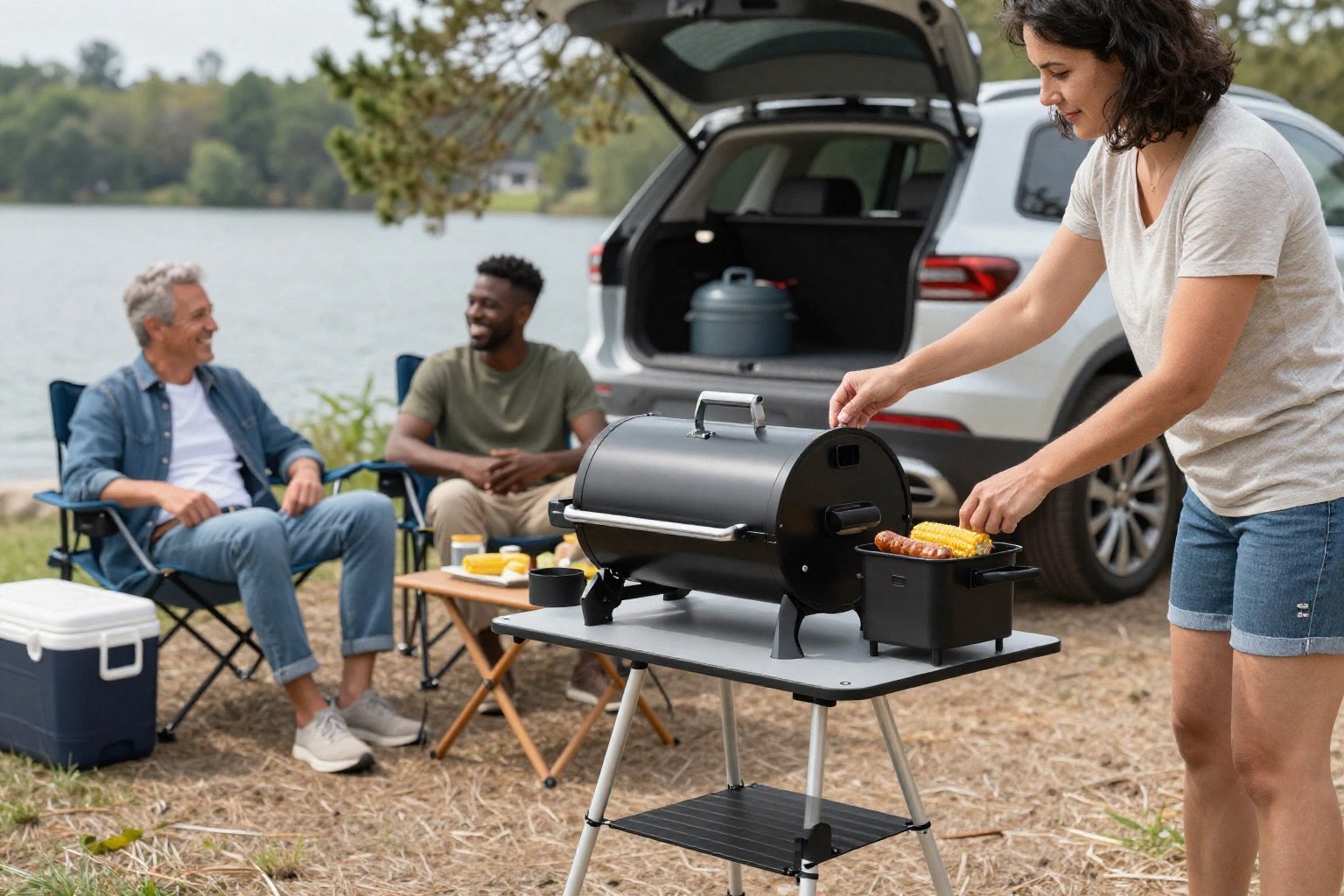
A portable pellet grill is a smaller pellet grill with folding legs or a tabletop body, built to fit in a car for camping, tailgates and RV trips. The real limit is power: the auger, fan and controller need electricity all the time, and the igniter draws several hundred watts at start-up, so you need an outlet, a big enough inverter or a 12 V model. Pack it only when it is cold, and keep the same clearances you would at home.
Affiliate disclosureAs an Amazon Associate we earn from qualifying purchases made through links on this page. Commissions never change our ratings.
Power is the first question
Every pellet grill is electric. Pit Boss’s PB700FB1 manual gives the numbers that matter on the road: the igniter draws 200 to 700 watts during start-up, the grill can run on a 12 V, 100 watt inverter if you light it manually, and an automatic start needs an inverter of at least 1,000 watts. Without shore power, that means a large portable power station or a generator, or a grill built for 12 V.
Green Mountain Grills takes the second route: its Trek Prime 2.0 runs on 12 V direct current inside and takes either a 110/220 V plug or a 12 V plug. At a campsite with hookups any pellet grill will do; for boondocking, the 12 V option is the simple one.
| Power source | What works | Note |
|---|---|---|
| Campsite or RV outlet | any portable pellet grill | GFCI outlet; outdoor-rated cord |
| 12 V car outlet, 100 W inverter | manual start only (Pit Boss) | igniter disconnected |
| 1,000 W inverter or power station | automatic igniter | per Pit Boss’s manual |
| 12 V plug | grills built for 12 V, e.g. GMG Trek | runs on 12 V DC inside |
Size, hopper and what you can cook
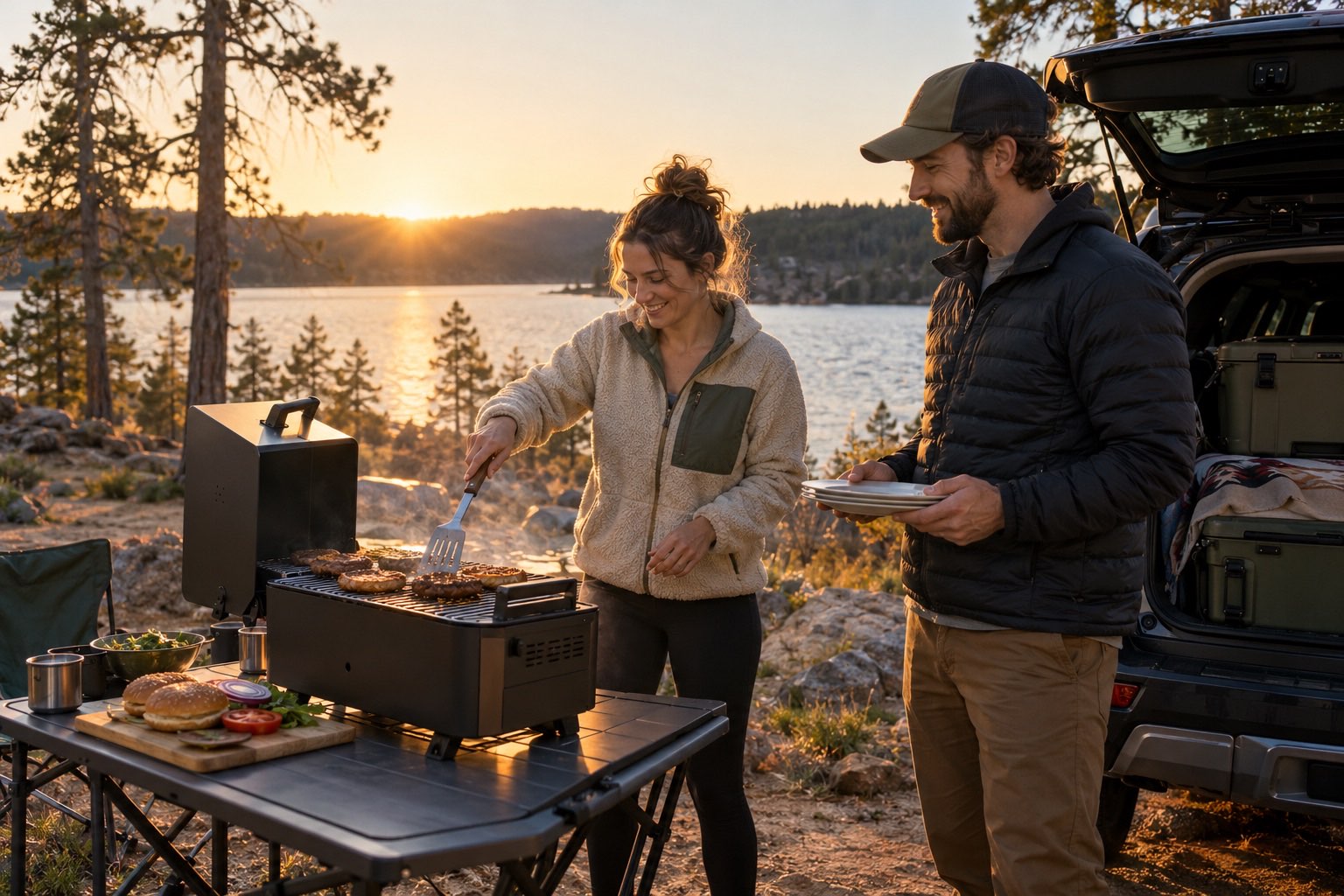
Portable grills trade grate and hopper for weight. Traeger’s Ranger has a 9 lb (4.1 kg) hopper, half the 18 lb of a Pro 22, and the Tailgater lists 300 sq in of cooking area. That is plenty for steaks, chicken thighs or a rack of ribs cut in half for four people, and tight for a party. If you plan a long smoke at camp, bring a sealed bucket of pellets: they must stay dry, and a damp campsite is hard on an open bag.
Low-and-slow still works on a portable, and the Ranger’s Keep Warm mode holds food at 165°F. Just expect to refill the small hopper on long cooks.
Setting up at the campsite or tailgate
- Clearances: Traeger asks for at least 18 inches (45.7 cm) from combustibles around a Ranger or Tailgater, and 40 inches (102 cm) under any overhead combustibles. Keep the awning out of the way.
- Surface: the Tailgater’s legs fold, but its manual says never to cook on a flammable surface with them folded, because heat through the bottom can discolor or warp the surface.
- Outdoors only: burning pellets produce carbon monoxide, and every manual we read limits the grill to outdoor use, away from enclosed spaces.
- Weather: Pit Boss advises against using its grills in rain; a gust also pulls heat out of a small barrel fast.
Packing up: the return trip
This is the step people rush. Traeger’s Ranger manual says the grill must never be moved while hot, and that the fire must be completely out and the grill cold before it goes in a vehicle. Run the full shutdown cycle, wait, and only then fold and load it. Never put water into the fire pot to speed things up: Traeger warns it jams the auger.
Empty the ash once it is cold and keep it in a metal container with a tight lid, as the Woodridge Pro manual describes. Grease in the bucket travels badly, so empty it before the drive, and line the tray with foil next time, a trick Green Mountain suggests for the Trek.
Which portable pellet grill fits your trips
- Car camping and tailgates: Traeger Ranger, our top portable at 9.3/10, with the 9 lb hopper and Keep Warm mode described above.
- More grate for a group: Traeger Tailgater with 300 sq in and folding legs per the listing.
- Off-grid or 12 V: Green Mountain Trek Prime (7.9/10), WiFi included.
- Bigger hopper on the go: recteq RT-B380 Bullseye, 380 sq in and a 15 lb hopper per the listing.
- Tabletop: Z Grills 200A Tabletop, 202 sq in per the listing, the lightest kind of setup.
All of them are compared in our portable pellet grill ranking. Home patio short on space? Our cooking area guide helps you size a compact grill.
Our rated picks
The three best-rated models of our best portable pellet grills ranking, from buyer reviews and the listed specs.


Product images: Amazon listings
Frequently asked questions
Can you run a pellet grill off a car battery?
With an inverter, yes, within limits. Pit Boss says its grills run on a 12 V, 100 W inverter with a manual start, and need at least a 1,000 W inverter for the automatic igniter. Grills like the GMG Trek run on 12 V directly.
What is the best travel pellet grill?
In our ranking the Traeger Ranger rates highest for portability. The Traeger Tailgater offers more grate area, and the Green Mountain Trek suits off-grid trips because it runs on 12 V.
How many watts does a pellet grill use?
Most of the draw is at start-up: Pit Boss quotes 200 to 700 watts for the igniter. After that the auger, fan and controller draw far less.
Can I put my pellet grill in the car right after cooking?
No. Traeger says the fire must be completely out and the grill cold before it goes in a vehicle. Run the shutdown cycle and let it cool first.
Sources
- Pit Boss — PB700FB1 wood pellet grill owner’s manual (PDF) (consulted Nov 2026)
- Green Mountain Grills — Trek Prime 2.0 owner’s manual (PDF) (consulted Nov 2026)
- Traeger — Ranger owner’s manual (PDF) (consulted Nov 2026)
- Traeger — Tailgater use and care instructions (PDF) (consulted Nov 2026)
- Traeger — Pro Series 22/34 owner’s manual (PDF) (consulted Nov 2026)
- Traeger (copy hosted by The Home Depot) — Woodridge Pro owner’s manual (PDF) (consulted Nov 2026)
Products mentioned
- Traeger Ranger (exact listing) · Rating and specs
- Traeger Tailgater (exact listing) · Rating and specs
- Green Mountain Trek Prime (exact listing) · Rating and specs
- recteq RT-B380 Bullseye (exact listing) · Rating and specs
- Z Grills 200A Tabletop (exact listing) · Rating and specs